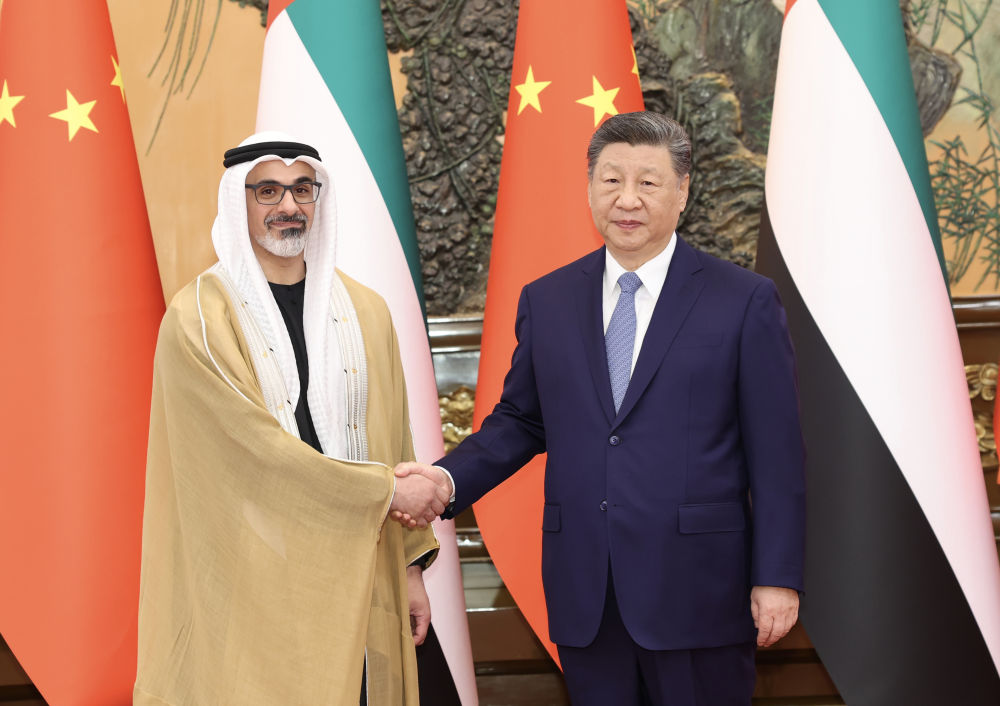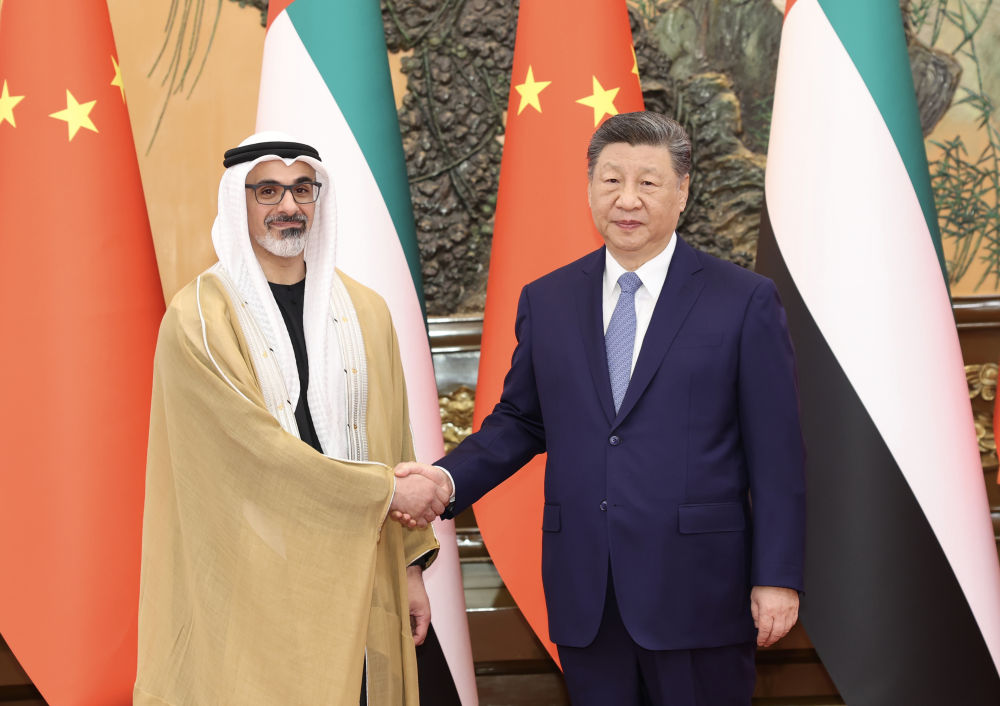
On the morning of April 14, President Xi Jinping met with visiting Crown Prince of Abu Dhabi, Khalid of the United Arab Emirates, at the Great Hall of the People in Beijing. Photo by Xinhua News Agency reporter Huang Jingwen
Xinhua News Agency, Beijing, April 14 (Reporter Wen Xin) On the morning of April 14, President Xi Jinping met with visiting Crown Prince of Abu Dhabi, Khalid of the United Arab Emirates, at the Great Hall of the People in Beijing.
Xi Jinping pointed out that the UAE is China's comprehensive strategic partner, and China has always attached great importance to developing relations with the UAE. With the joint efforts of both sides, China-UAE relations have maintained healthy and stable development, political mutual trust has been continuously deepened, practical cooperation has been steadily advanced, and people-to-people and cultural exchanges have been rich and colorful. Consolidating and enhancing China-UAE relations is a firm consensus between both sides and meets the expectations of the two peoples. China is willing to join hands with Afghanistan to build a more stable, resilient and dynamic comprehensive strategic partnership between China and Afghanistan. The two sides should continue to support each other on issues involving each other's core interests and major concerns, maintain high-level exchanges, and build strategic mutual trust. Strengthen the docking of development strategies, tap potential in energy, investment, trade, science and technology and other fields, and deepen mutually beneficial cooperation. Promote greater progress in cooperation in education, civil aviation, tourism, etc., intensify people-to-people and cultural exchanges, and consolidate the foundation of public opinion. Enhance coordination and cooperation at multilateral platforms such as the United Nations and BRICS, use the stability of China-Arab relations to respond to the uncertainty of the international and regional situation, and jointly promote the building of a community with a shared future for mankind.
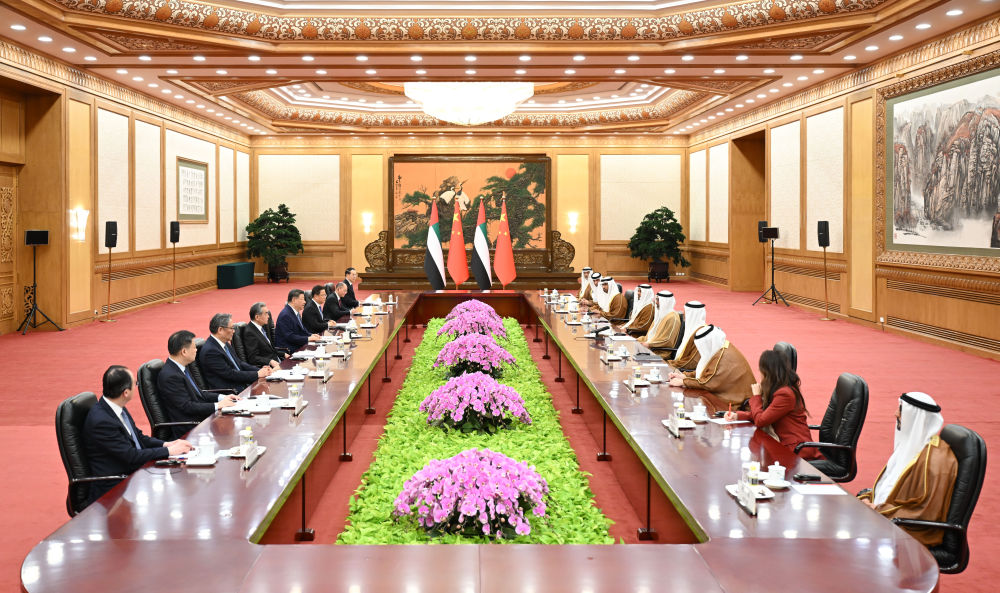
On the morning of April 14, President Xi Jinping met with visiting Crown Prince of Abu Dhabi Khalid of the United Arab Emirates at the Great Hall of the People in Beijing. Photo by Xinhua News Agency reporter Li Xiang
The two sides exchanged views on the current situation in the Middle East and the Gulf region. Xi Jinping emphasized China's principled position in promoting peace and talks and reiterated that it will continue to play a constructive role in this regard.
Xi Jinping put forward four propositions on maintaining and promoting peace and stability in the Middle East: First, adhere to the principle of peaceful coexistence. The Gulf countries in the Middle East are closely intertwined and are neighbors that cannot be moved away. It is necessary to support the Middle East and Gulf countries in improving relations, promote the construction of a common, comprehensive, cooperative and sustainable security architecture in the Middle East and the Gulf region, and build a solid foundation for peaceful coexistence. The second is to adhere to the principle of national sovereignty. Sovereignty is the basis for all countries, especially developing countries, to settle down and live, and it cannot be violated. The sovereignty, security and territorial integrity of the Middle East and Gulf countries should be effectively respected, and the security of personnel, facilities and institutions in various countries should be effectively maintained. The third is to adhere to the principle of international rule of law. To maintain the authority of the international rule of law, we cannot "use it if it works and discard it if it doesn't work", and we cannot let the world revert to the law of the jungle. We must firmly safeguard the international system with the United Nations at its core, the international order based on international law, and the basic norms of international relations based on the purposes and principles of the United Nations Charter. The fourth is to insist on coordinating development and security. Security is the prerequisite for development, and development is the guarantee of security. All parties should create a good environment and inject positive energy for the development of the Gulf countries in the Middle East. China is willing to share opportunities for Chinese-style modernization with the Gulf countries in the Middle East to cultivate regional development and security.
Khalid said that Afghanistan-China relations have a long history and deep roots. The two countries have always respected and trusted each other and share extensive common interests. Afghanistan attaches great importance to developing relations with China and is willing to work with China to implement the important consensus reached by the two heads of state, deepen cooperation in various fields, open up broader prospects for bilateral relations, and benefit the two peoples. The Arab side appreciates China for playing a responsible and constructive role in international affairs and for making active efforts to politically resolve the current Middle East crisis. Afghanistan is committed to maintaining close communication and coordination with China, promoting a ceasefire and an end to war among relevant parties, restoring regional peace and stability as soon as possible, safeguarding international shipping safety, and preventing greater impact on the global economy and energy security. Afghanistan will effectively protect the safety of Chinese citizens and institutions in Afghanistan.
Wang Yi attended the meeting.